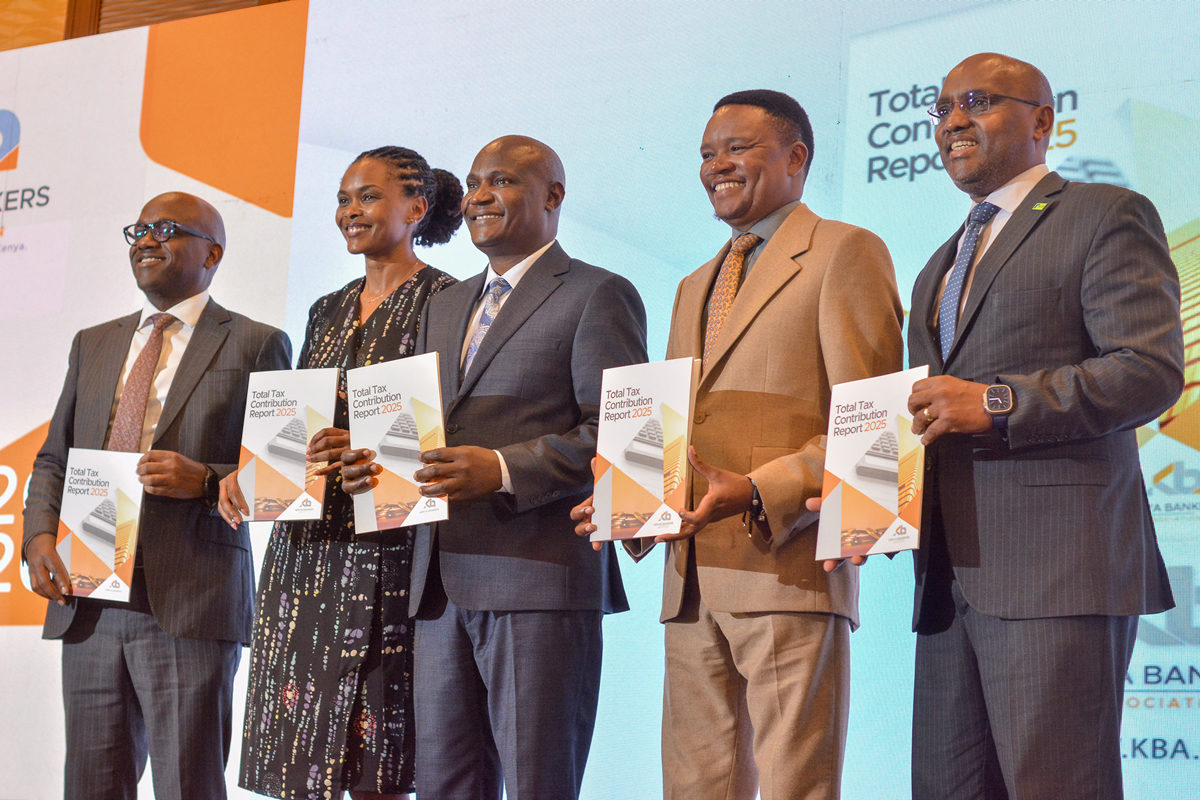
Nairobi, October 22, 2026 – Kenya’s banking sector contributed KES 205.58 billion in taxes in 2025, an increase of 5.53% from KES 194.81 billion in 2024, according to the 2026 Total Tax Contribution Report released today by Kenya Bankers Association (KBA).
The contribution was equivalent to 8% of total government receipts and comprised KES 98.36 billion in taxes borne directly by participating institutions and KES 107.22 billion in taxes collected on behalf of the Government.
Prepared by PwC Kenya in collaboration with KBA, the report draws on data from 33 institutions, comprising 31 banks and two microfinance institutions, representing 96.9% of the banking sector by net assets.
Speaking at the release, National Treasury and Economic Planning Cabinet Secretary John Mbadi said the Government continues to engage stakeholders on tax reforms to strengthen compliance, improve tax legislation and support a predictable investment environment.
“The National Treasury will continue to engage stakeholders on reforms to improve the coherence of tax legislation, strengthen compliance, and support a predictable investment environment. Sustained revenue mobilisation also depends on the prudent use of public resources and confidence in the management of public finances,” said Mr. Mbadi.
The report shows a shift in the composition of taxes collected by participating institutions. Withholding Tax Collected rose by 29.40%, from KES 33.97 billion in 2024 to KES 43.95 billion in 2025, becoming the largest category of taxes collected. People Taxes Collected increased by 6.40% to KES 36.81 billion, while Excise Duty Collected rose by 5.46% to KES 23.90 billion.
Some individual tax categories recorded significant increases, including withholding tax on professional fees, which rose by 292%, and withholding tax on royalties, which increased by 159%. Social Health Insurance Fund (SHIF) collections rose by 221.43%, while National Social Security Fund (NSSF) contributions increased by 126.44%.
The banking sector’s Total Tax Contribution has more than doubled since 2018, rising by 107.66% from KES 99 billion to KES 205.58 billion. Over the same period, net assets grew by 89.42% to KES 8.35 trillion, while customer deposits increased by 87.73% to KES 6.12 trillion.
Corporate Tax borne by participating institutions increased by 2.06%, from KES 69.41 billion in 2024 to KES 70.84 billion in 2025. The institutions accounted for 22.15% of total government Corporate Tax collections. The report notes that Corporate Tax growth was modest compared with the increase in profits before tax, partly reflecting increased investment in tax-exempt government securities.
The report also highlights the cost of tax compliance. The average annual compliance cost per participating institution rose by 62.25%, from KES 19.10 million in 2024 to KES 30.99 million in 2025. Institutions spent an average of 103 business hours per month on compliance and made approximately 45 tax payments monthly. The average annual cost of external tax consultants was KES 20.22 million per institution.
Finance and National Planning Committee Chair Kimani Kuria emphasised the need to balance revenue mobilisation with the conditions that enable businesses to grow, households to thrive and jobs to be created.
As Parliament prepares to consider the Finance Bill, 2027, Mr. Kuria called for a fair, predictable and efficient tax framework that raises the revenue needed by the country without undermining the economic activity that generates it.
“The answer lies in a tax framework that is fair, predictable, efficient; and ensures that public resources are used responsibly to improve the lives of all,” he said.
KBA Chief Executive Officer Raimond Molenje called for tax adjustments that help restore public trust in Government and encourage Kenyans to continue contributing to the economy.
“As we make Pay As You Earn adjustments, let’s consider how we can help Kenyans restore trust in their government. The proposed 5% tax cut for all workers is not merely about putting more money in people’s pockets. It is also about rebuilding trust in government and encouraging Kenyans to continue contributing to the economy,” said Mr. Molenje.
Alice Muriithi, Partner, Tax and Legal Services at PwC Kenya, said the Total Tax Contribution framework provides a broader view of the role businesses play in supporting public finances.
“Looking beyond Corporate Tax to include taxes borne and taxes collected helps demonstrate the full extent of the banking sector’s contribution. The findings also point to the importance of continued collaboration between policymakers, revenue authorities and taxpayers to simplify reporting obligations, improve the functionality and integration of digital tax platforms, and create a more predictable tax environment. This can support efficient compliance while fostering sustainable economic growth,” she said.
The report recommends continued investment in automation, integrated tax systems, predictable tax legislation and practical filing and payment requirements to support compliance while reducing the administrative burden on businesses.
To read the full report, kindly click here.
Media Contacts
Christine Onyango
Director, Communication and Public Affairs
Kenya Bankers Association
Email: conyango@kba.co.ke
About Kenya Bankers Association
The Kenya Bankers Association (KBA) is the umbrella body for all commercial banks in Kenya and is regulated by the Central Bank of Kenya (CBK). Established on 16th July 1962, KBA represents 46 member institutions with combined assets exceeding KES 7.7 trillion. Its core mandate is to promote a stable, competitive, and inclusive banking industry by influencing legislation, regulation, and policy to enhance access to affordable credit for individuals, households, and businesses. KBA also drives financial sector development through strategic initiatives, including the launch of Pesalink, the industry’s first peer-to-peer digital payments platform. In partnership with the CBK and other stakeholders, KBA has spearheaded projects such as the modernization of the National Payments System, implementation of the Real Time Gross Settlement System (RTGS), and the Kenya Credit Information Sharing Initiative. Guided by its brand statement, “One Industry. Transforming Kenya,” KBA continues to strengthen the banking sector, foster innovation, drive financial inclusion, and support national economic growth. Learn more: www.kba.co.ke