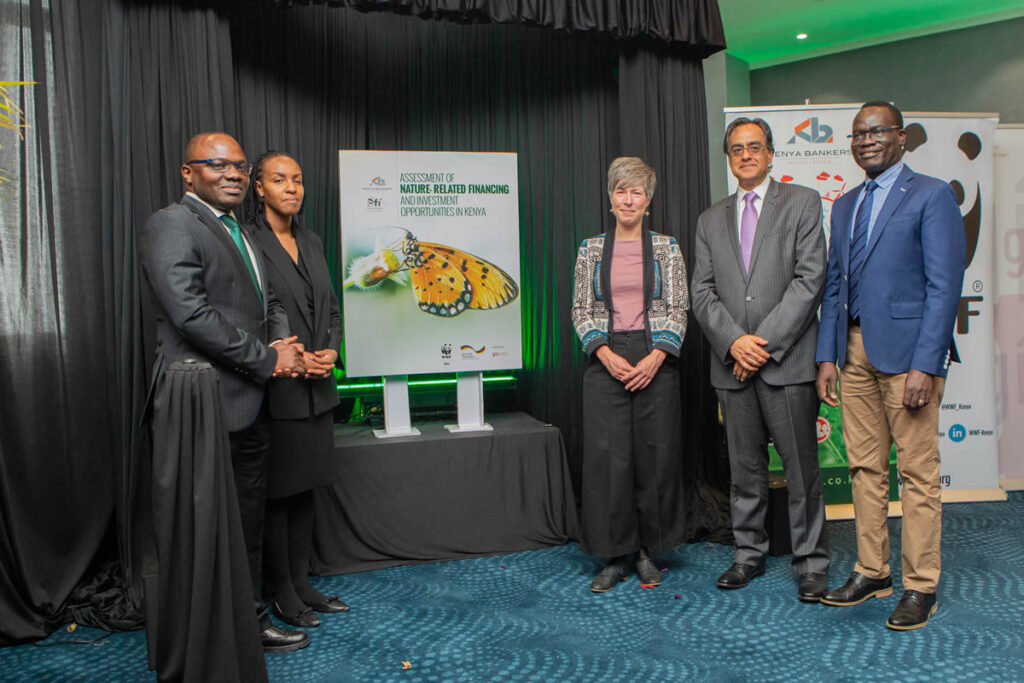
Nairobi, Friday, September 12, 2025: Banking industry umbrella body, Kenya Bankers Association (KBA), has today launched the KBA Centre for Sustainable Finance and Enterprise Development (CSFED) in partnership with WWF-Kenya, GIZ, and IUCN. The Centre will rally banks to develop interventions that advance sustainable value for society and the environment, fostering growth for people, nature, climate, and the economy.
Besides promoting sustainable finance practices within the banking sector, the Centre will support MSME transformation through capacity building and enhanced access to finance. KBA CEO, Raimond Molenje, said the Centre will be instrumental in greening the financial system while bolstering enterprise development in Kenya. “We are committed to supporting the industry in advancing the sustainable finance agenda in the country while also promoting financial inclusion for underserved segments, and enhancing MSMEs’ access to affordable finance,” said Mr. Molenje.
During the launch, KBA also unveiled the Assessment of Nature-Related Financing and Investment Opportunities Report, which reveals that Kenya’s manufacturing, water resource management, environmental services, and agriculture sectors hold combined nature-related investment and financing opportunities valued at USD 100–150 billion over the next 5 to 10 years.
Speaking during the launch, Mohamed Awer, WWF-Kenya Chief Executive Officer, said: “Kenya’s prosperity is deeply tied to nature, with nature-based sectors, including agriculture, tourism, forestry, and fisheries, contributing approximately 42% of the country’s GDP. This report showcases the intersectional role the financial sector plays in driving a nature-positive economy and how we can close the biodiversity finance gap. Together, we can continue to chart a transformative pathway to economic resilience, climate stability, and inclusive growth for people and the planet.”
Maren Kneller, Head of Development Cooperation, Embassy of the Federal Republic of Germany, said: “Today’s launch is about more than a study. It’s about reframing how we view and finance Nature-based Solutions (NbS) not merely as conservation efforts, but as long-term, high-impact investments in resilience, equity, and sustainability. However, several barriers remain: limited access to reliable data, technical capacity gaps, and the absence of robust, supportive policy frameworks. Overcoming these challenges will require coordinated, multi-stakeholder action.”
Luther Anukur, Regional Director, IUCN Eastern and Southern Africa region, said: “At IUCN, we believe that Nature is a core asset to be valued and invested in. By integrating nature risks and opportunities in financial decision-making, we can unlock innovation, drive resilient growth, and protect natural capital that underpins our prosperity.”
The report highlights Kenya’s investment potential, barriers, and solutions for creating bankable projects. Conducted by Rebel on behalf of KBA, WWF-Kenya, and GIZ, it identifies innovative instruments such as green bonds, blended finance, and de-risking mechanisms (including guarantees) as key enablers.
The four sectors present the most viable opportunities for nature-positive financing, providing banks with options to contribute to Kenya’s sustainable economic development, curb nature loss, and strengthen climate resilience, in alignment with national policies and strategies.
Overall, the study calls for a stronger enabling policy environment, improved data availability on nature-related investment opportunities, and enhanced technical expertise to scale Kenya’s nature-financing market.
Summary of Report Findings
Agriculture: The most relevant sector for nature-positive outcomes, with investment and financing demand estimated at USD 500 million in the next six months, rising to USD 1.7–2 billion over the next two years.
Wildlife Conservation: Critical for nature protection, with short-term financing needs of USD 50 million, medium-term of USD 200 million, and USD 1 billion in the long term.
Manufacturing: Holds major potential for a “do no harm” approach, with demand projected at USD 1 billion in the short term, USD 4 billion in the medium term, and USD 20–30 billion in the long term.
To read the full report, kindly click here.
Media Contacts
Christine Onyango
Director, Communication and Public Affairs
Kenya Bankers Association
Email: conyango@kba.co.ke
About Kenya Bankers Association
The Kenya Bankers Association (KBA) is the umbrella body for all commercial banks in Kenya, regulated by the Central Bank of Kenya (CBK). Established on 16th July 1962, KBA represents 46 member institutions with assets exceeding KES 7.7 trillion. The Association’s core mandate is to champion a stable, competitive, and inclusive banking industry by influencing legislation, regulation, and policy to enhance access to affordable credit for individuals, households, and businesses. KBA also drives financial sector development through strategic initiatives such as the launch of Pesalink, the industry’s first peer-to-peer digital payments platform. In partnership with the CBK and other stakeholders, KBA has also spearheaded key projects including the modernization of the National Payments System, the implementation of the Real Time Gross Settlement System (RTGS), and the Kenya Credit Information Sharing Initiative. Guided by its brand statement, One Industry. Transforming Kenya, KBA continues to promote a strong and professional banking sector that advances innovation, fosters financial inclusion, and supports national economic growth. Learn More: www.kba.co.ke.
About WWF-Kenya
World Wide Fund for Nature Kenya (WWF-Kenya) is a locally registered non-governmental conservation organization; an affiliate of WWF International. WWF has been working in Kenya since 1962 alongside the government, civil society, private sector organizations, and local communities to contribute towards providing an enabling environment for the achievement of a healthy natural environment supporting people and sustainable development in Kenya.
About IUCN
IUCN is a membership Union composed of both government and civil society organisations. It harnesses the experience, resources and reach of its more than 1,400 Member organisations and the input of more than 17,000 experts. IUCN is the global authority on the status of the natural world and the measures needed to safeguard it.

