
What if the safety net is part of the problem?
For decades, lending against security; the title deed, the logbook, the stock in the warehouse, has been the gold standard of prudent banking. But what if the collateral we demand is quietly licensing the very risk it is meant to contain? Is collateral encouraging reckless lending? Why would a secured MSME loan default more readily than one with no security at all? And when a borrower stops paying, what does the asset in the vault actually protect?
This quarter’s analysis first, presented at the EABS Research Conference in July, draws on the latest release of KBA’s MSME Gender-Disaggregated Credit Dashboard, which now tracks 1.32 million loans, 718,000 unique borrowers and KES 586.6 billion in outstanding MSME credit across banks, microfinance banks, SACCOs and digital credit providers. Before we answer the collateral question, two pieces of context matter: a stubborn NPL number, and a sector map of where the stress sits. Then the data delivers an answer that should change how we underwrite.
For six consecutive months, Kenya’s MSME non-performing loan (NPL) ratio has held in the 23–24% band, closing May 2026 at 24.1%. That is roughly nine percentage points above the total banking NPL ratio. In absolute terms, KES 233.4 billion of the MSME book is not being repaid as agreed, and KES 42.7 billion has already been written off. That write-off figure is capital permanently lost, down 18% from the prior period but still equivalent to the entire loan book of a mid-tier bank.
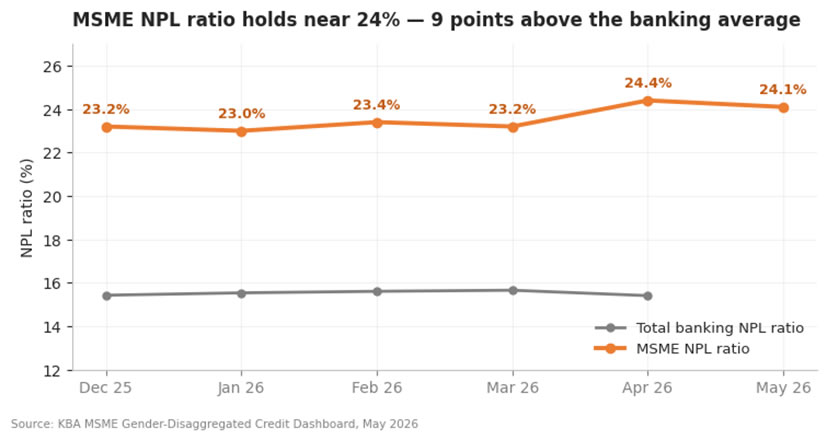
Figure 1: MSME NPL ratio vs total banking NPL, December 2025 to May 2026.
A 24.1% NPL ratio tells us there’s a problem. But it doesn’t tell us where the problem is. Is the risk concentrated in certain sectors? Among younger borrowers? In specific counties? Are unsecured loans driving the trend? Do women- and men-owned businesses perform differently? To answer those questions, we moved beyond the headline number and disaggregated down by sector, client type, age, geography, collateral status and gender. That’s where the real story begins.
Agriculture is the riskiest formal sector in the book, with an NPL ratio of 28.2%; a predictable story of seasonality, weather shocks and commodity price swings that our underwriting has yet to price properly. Trade follows at 26.8%, and Trade matters twice over: it accounts for 38% of the entire MSME portfolio, so its elevated NPL translates into KES 38.3 billion value at risk, the largest single-sector exposure in the market. Because trade accounts for the largest share of MSME lending, deterioration in the sector has implications for the performance of the overall portfolio.
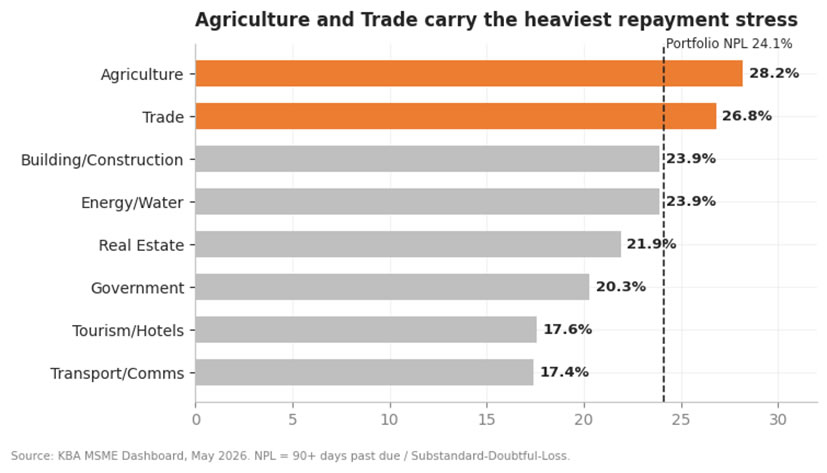
Figure 2 : NPL ratio by economic sector, May 2026. Dashed line: portfolio average (24.1%).
Geography compounds concentration. Nairobi alone holds 25% of the portfolio (KES 146.7 billion), meaning a shock to the capital’s economy, a rates squeeze, a supply disruption, even prolonged maandamano shocks through the entire banking system. Individual, unregistered traders run an NPL ratio of 28.3% against 20.3% for registered legal entities, an eight-point gap worth about KES 28 billion in additional overdue exposure. Small tickets, it turns out, do not mean small risk.
So, is collateral encouraging reckless lending?
Now to the question itself. Conventional banking wisdom says security makes a loan safer. Demand a title deed and risk falls. Our data says the opposite: collateralized MSME loans carry an NPL ratio of 28.4%, against 22.4% for uncollateralized loans. Worse, collateralized loans are being written off at more than twice the rate, 4.1% versus 1.8%. The loans we consider safest are performing like our riskiest.
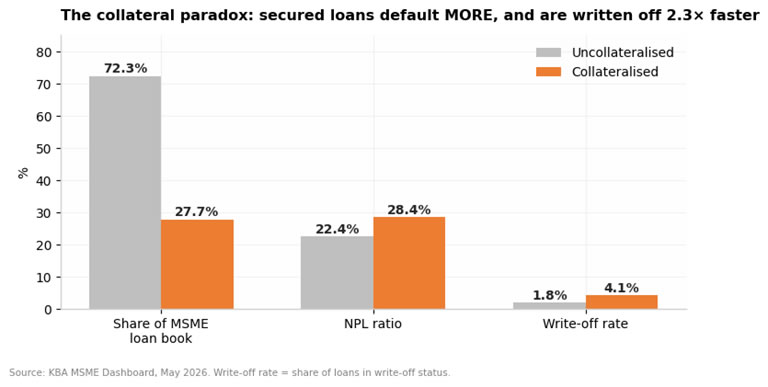
Figure 3: Collateralized vs uncollateralized MSME lending, May 2026.
Is that recklessness? The honest answer: not by intent, but by design, it can look uncomfortably close. Three forces are at work:
First, negative selection. Collateral is rarely asked of our best borrowers; it is demanded as compensating control from borrowers we are already unsure about. The secured pool is riskier by design before a single shilling moves. Second, collateral does not improve repayment behavior, it only changes the recovery path, and that path is weakening. Valuation gaps, thin secondary markets for seized assets and recovery timelines measured in years mean the title deed in the vault is worth less than the model assumes. Third, the unsecured portfolio is its own quiet emergency: KES 154.6 billion of overdue uncollateralized exposure has no backstop at all, so loss given default there approaches 100%.
Collateral changes the recovery path, but does not change the credit quality. We are pricing security when we should be pricing the borrower. The practical lesson is that collateral alone is not a guarantee of portfolio quality. Effective credit risk management requires a balanced approach that combines robust cash-flow assessment, realistic collateral valuation and proactive portfolio monitoring, particularly for unsecured exposures.
When disaggregated by gender a familiar pattern reappears, but with a twist that should end an old excuse. Women-owned businesses account for 46% of unique MSME borrowers and 42% of loans yet receive only 27% of outstanding credit value: for every KES 1,000 lent to men-led businesses, women-led businesses get about KES 375.
And the risk defence? Female-owned businesses run an NPL ratio of 26.3% against 25.0% for male-owned, a gap of just 1.3 percentage points, too small to justify a two-thirds disparity on credit value. Women’s share of the bad book (KES 22.5 billion of value at risk) is far below men’s (KES 56.4 billion). The more plausible reading of the slightly higher female NPL is rationing: when credit is scarce, only the most pressured women borrowers make it through the door, and they are handed smaller, shorter, more expensive loans.
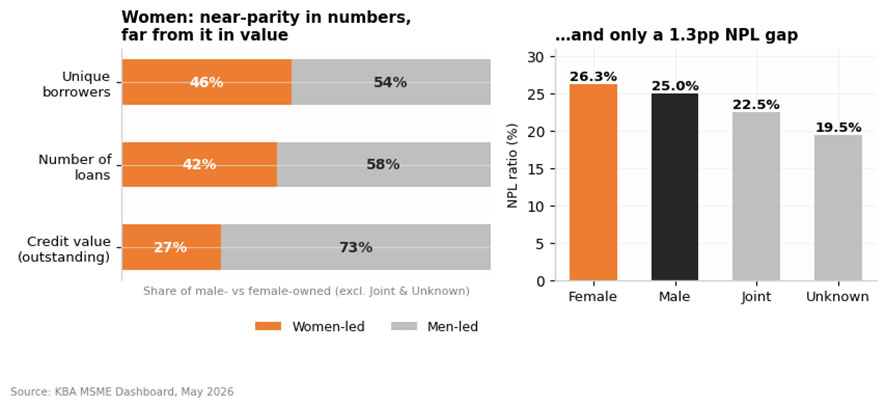
Figure 4: Women’s share of MSME credit (male- vs female-owned) and NPL ratio by gender, May 2026.
The collateral question has a gender edge too. Within the collateralized book, women-led businesses hold a 24.1% value share, against just 16.9% of the uncollateralized book. We ask women for more security, to lend them less money, for performance that is statistically indistinguishable from men’s. This is also a warning for the AI era. Models trained on historical lending data will learn these patterns of exclusion and reproduce them at scale. Every credit model in this market should be audited for demographic parity and predictive equity, measuring genuine risk, not inherited bias.
Three calls to action close this quarter’s reading:
One, for credit teams: treat collateral as a recovery tool, never an underwriting substitute. Invest in cash-flow appraisal, especially for individual borrowers and the agriculture and trade portfolios where stress is concentrated.
Two, for risk and data teams: disaggregation is your early-warning system. A 24.1% average hides a 28.4% secured-loan problem, a 28.2% agriculture problem and an 81.3% digital-credit problem. Segment, monitor, and price each on its own evidence.
Third, for the wider ecosystem: Kenya now has the data infrastructure to move from intuition to evidence. The dashboard provides an unprecedented view of where credit is flowing, where risks are concentrated and where financing gaps persist. The challenge now is to use these insights to inform product development, strengthen risk management and shape policies that expand access to sustainable finance for underserved MSMEs.
Christine Waita is Data and Compliance Manager at Kenya Bankers Association (KBA)
About the data
All figures are drawn from the KBA MSME Gender-Disaggregated Credit Analysis Dashboard (msmedata.kba.co.ke), built on Metropol CRB records across banks, MFBs, SACCOs, DFIs and digital credit providers, as of May 2026. A loan is non-performing at 90+ days in arrears or when classified Substandard, Doubtful or Loss. Value at Risk = segment NPL ratio × segment outstanding. Gender comparisons exclude Jointly-Owned and Unknown categories unless stated.