
There is a familiar narrative about women and credit in emerging markets: that they struggle to access it, that they operate at the margins, that risk follows them more closely than it does men. But the latest data from Kenya’s MSME lending market tells a more uncomfortable story: one not about exclusion, but about systematic underestimation.
According to the data compiled by the banking industry umbrella body, Kenya Bankers Association (KBA), women are not absent from the financial system. They account for 48 per cent of MSME borrowers, only slightly behind men at 52 per cent.
Still, this near-parity in participation dissolves when measured by capital. Of the roughly KES 613 billion in outstanding MSME credit, women hold just 26 per cent. Men hold the remaining 74 per cent. For every KES 1,000 extended to male-owned enterprises, women-owned businesses receive only KES 354. The disparity is not subtle. It is structural.
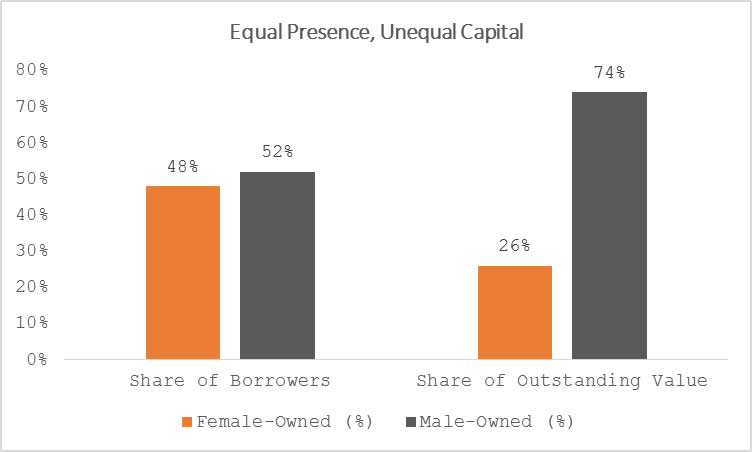
Figure 1: Equal presence in borrower count, unequal share of capital
The imbalance becomes more pronounced at the level of individual loans. On average, women-owned businesses receive KES 391,600, compared with KES 741,600 for male-owned firms. Within banks, the gap widens: KES 177,800 for women against KES 484,300 for men.
In trade finance, the very credit product that allows businesses to scale, manage inventory, and participate in supply chains, the gap is even sharper, with women receiving less than half of what men do.
Risk is often invoked to justify this pattern. Yet here, too, the evidence runs counter to assumption. At a glance, non-performing loan rates for men and women appear nearly identical: 25.0 per cent for women, 24.8 per cent for men.
But the surface parity obscures a deeper divergence. Women tend to default more frequently on smaller loans, while men default less often but on significantly larger amounts. Measured by value, the two appear similar. Measured by behavior, they are not.
More telling is what happens when the data is broken down by institution type. Across banks and microfinance institutions, women consistently exhibit lower NPL rates than men. In banks, the gap is particularly stark.
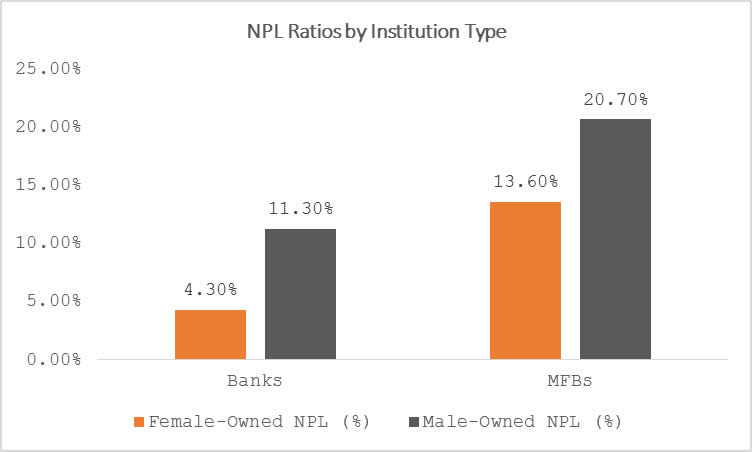
Figure 3: Female NPL is lower than male NPL across banks and MFBs
The implication is difficult to ignore; women are not inherently riskier borrowers. In many cases, they are the more reliable ones. This raises a more fundamental question about what is driving default. The data points not to borrower behavior, but to loan design. When businesses receive less capital than they need to operate effectively, cash flow gaps become inevitable. A loan that is too small to sustain operations does not reduce risk; it creates it.
Evidence of this dynamic appears in working capital loans, where loan sizes more closely align with business needs. Here, women perform better than men, with significantly lower default rates. When the capital is sufficient, the repayment follows.
Even long-held assumptions about collateral begin to unravel under scrutiny. Collateralized loans, often viewed as safer, show higher default rates than uncollateralized ones for both men and women. For women, the difference is clear. Rather than mitigating risk, collateral requirements may be distorting lending decisions in ways that ultimately weaken loan performance.
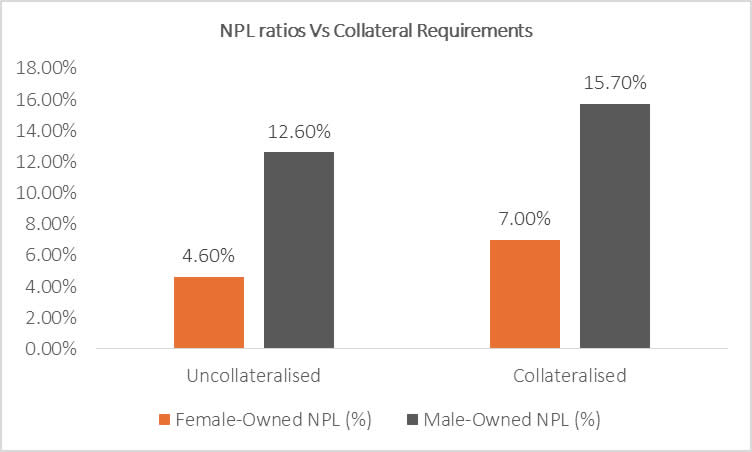
Figure 4: Uncollateralized loans outperform collateralized for both genders
What emerges from this data is not simply a question of gender disparity, but an opportunity to rethink how credit is structured and deployed.
Aligning loan sizes more closely with actual business needs, strengthening product design, and leveraging data-driven credit assessment can significantly improve outcomes for both borrowers and lenders.
A more precise allocation of capital would not only support women-owned enterprises to scale, but also enhance portfolio performance and deepen overall financial inclusion across the system.
The writer is a data and compliance expert and supports the Kenya Bankers Association Research and Policy Department.
Access the MSME Gender-Disaggregated Credit Dashboard here: https://msmedata.kba.co.ke/

